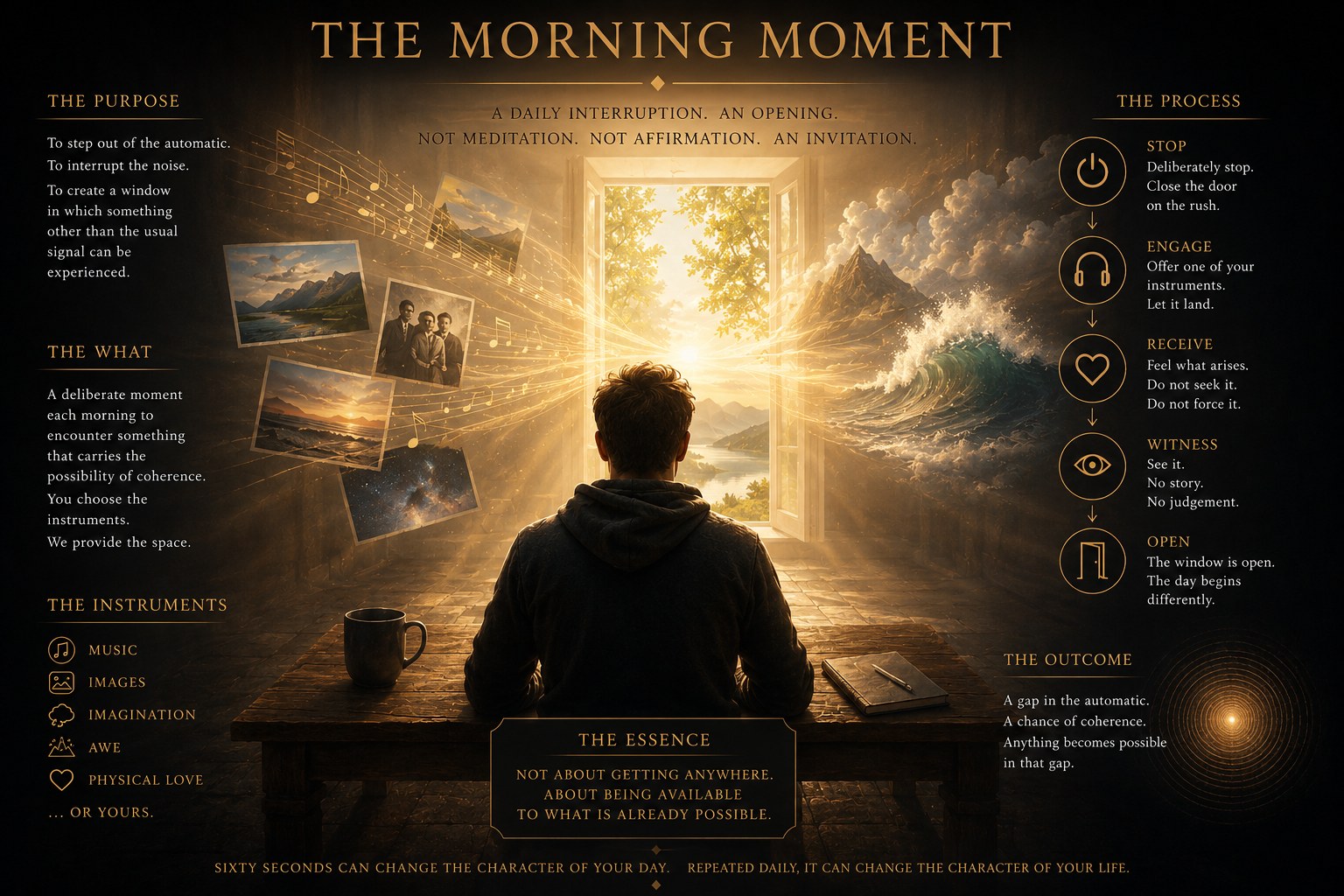
The Morning Moment
Your daily interruption. Your opening.
The Morning Moment is the deliberate interruption at the centre of the Stand-Down. Once each morning, you stop and offer yourself something capable of carrying the possibility of coherence: music, an image, a memory, awe, physical love, or something entirely your own. You do not try to manufacture a state. You simply make yourself available to what arises. If something is felt, receive it. Notice where it appears in the body. Do not explain it, improve it or turn it into a story. Witness it. What begins as a brief opening becomes a reference: a felt experience of yourself with less interference in the way. There is no required duration. A minute may be enough. Stay for an hour if you want. The point is not how long you remain there, but that for sixty days you return. The Morning Moment does not create coherence. It gives you somewhere to notice it.

The Marker
Where it starts — a moment you already own.
Before you change a single thing, you find one true moment. A time you felt clear, settled, completely yourself, often carried back by a memory or a piece of music. That moment is your marker: proof, held in your own body rather than in your head, of what you are like when nothing is in the way. You'll return to it each morning. It isn't nostalgia, and it isn't wishful thinking. It's a signal you already carry, brought forward into today.
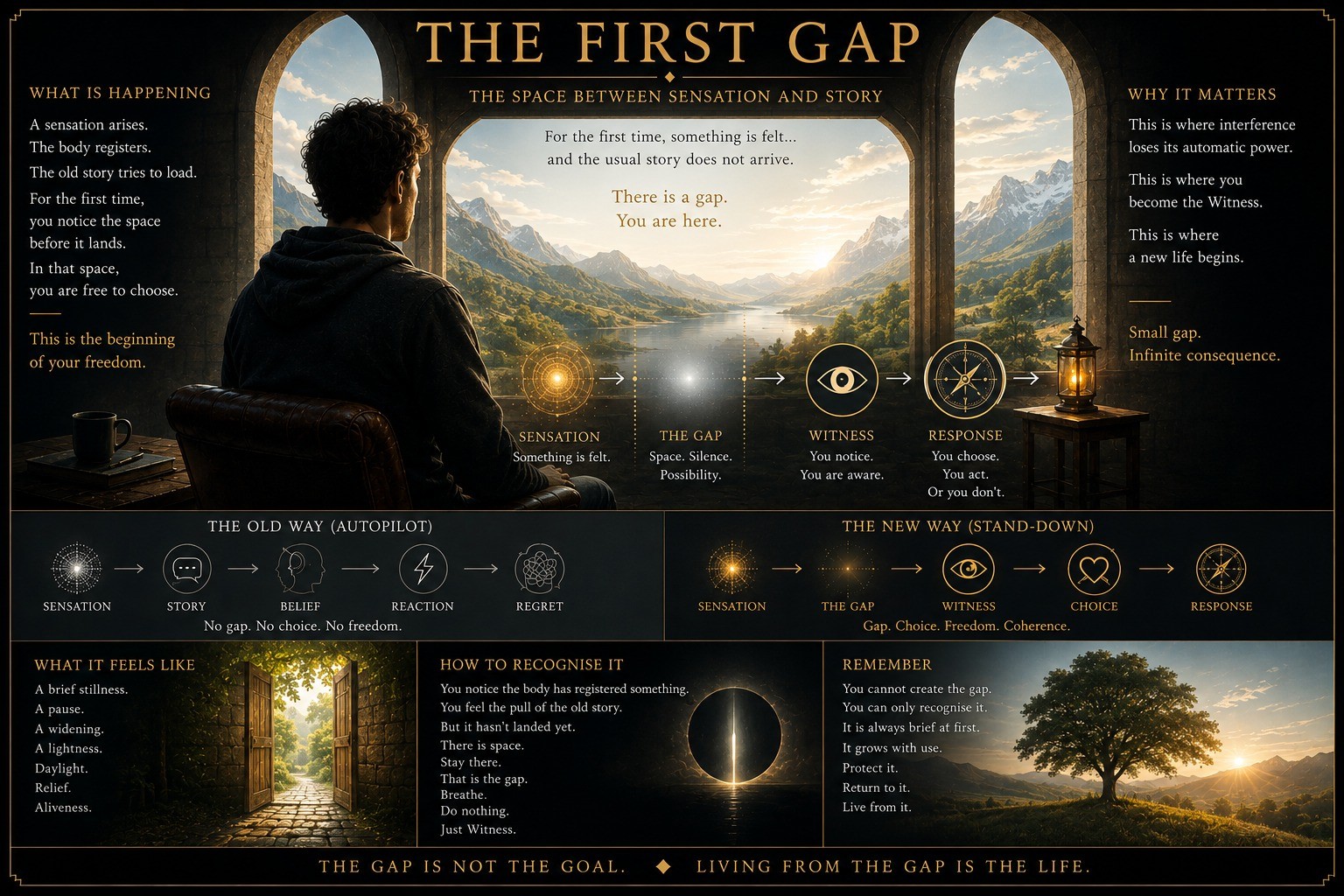
The First Gap
The first thing you'll notice.
Something happens, and normally the feeling and the reaction arrive fused together, no space between them at all. The first real change is a small pause opening up: a gap between the thing you feel and the story your mind rushes to tell about it. It can last half a second. But in that half-second, for the first time, you get to choose your response instead of firing it automatically. A different life doesn't begin with a grand decision. It begins in that tiny space.
The Journal
Your space, your words.
Each day you write, briefly, in your own words, with no form to fill in and no right answer. It isn't a diary of how you feel. It's a place to notice what actually happened and set it down. Two minutes is plenty. The writing itself isn't the point; the noticing is.

The Journal
What the writing quietly does.
Three small movements, every time. You capture the moment as it really was. You clarify it: see it plainly, separated from the story wrapped around it. And you let it complete: feel it run its course and pass, instead of carrying it around for the rest of the day. Done often enough, the old reactions stop being fed. And what isn't fed, fades.

The Record
The evidence builds itself.
Quietly, in the background, the app keeps a record, not of your opinions or your mood, but of what actually happened. The moment came. You noticed it. It passed. Day after day, that evidence stacks up, until it becomes the one thing the mind can't argue its way out of: proof, in your own hand, that things are genuinely changing.

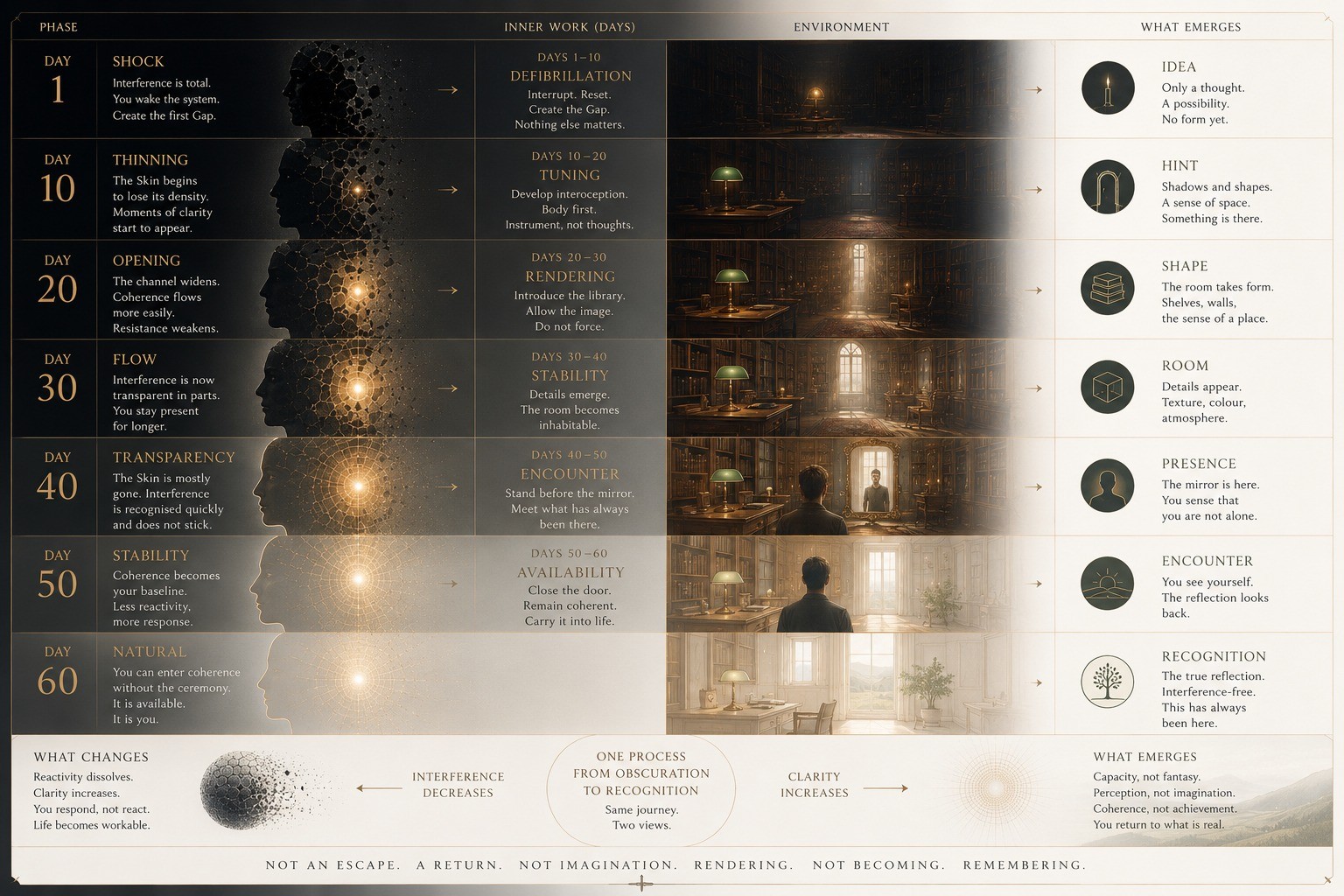
The full sixty-day journey, stretch by stretch
The shape of the sixty days.
The path moves through six ten-day stretches, from the first jolt to a settled baseline. It opens with Defibrillation: the early days, when the system is shocked awake. Then Tuning, where you learn to read what is actually firing and where it sits. Then Rendering, as something starts to come into focus. Then Stability, as the clear channel holds for longer and what surfaces runs its course and leaves. Then Encounter, where you meet what has been there all along. And by day sixty, Availability, which is not a finish line and not a graduation, but simply the point where clarity is there for you as a matter of course. The stretches are ten days each and the sixty days are sixty days. What moves is where inside them a given thing shows up for you.
Day 60 is the Availability stretch. Natural is what the interference has become by the time you get there.
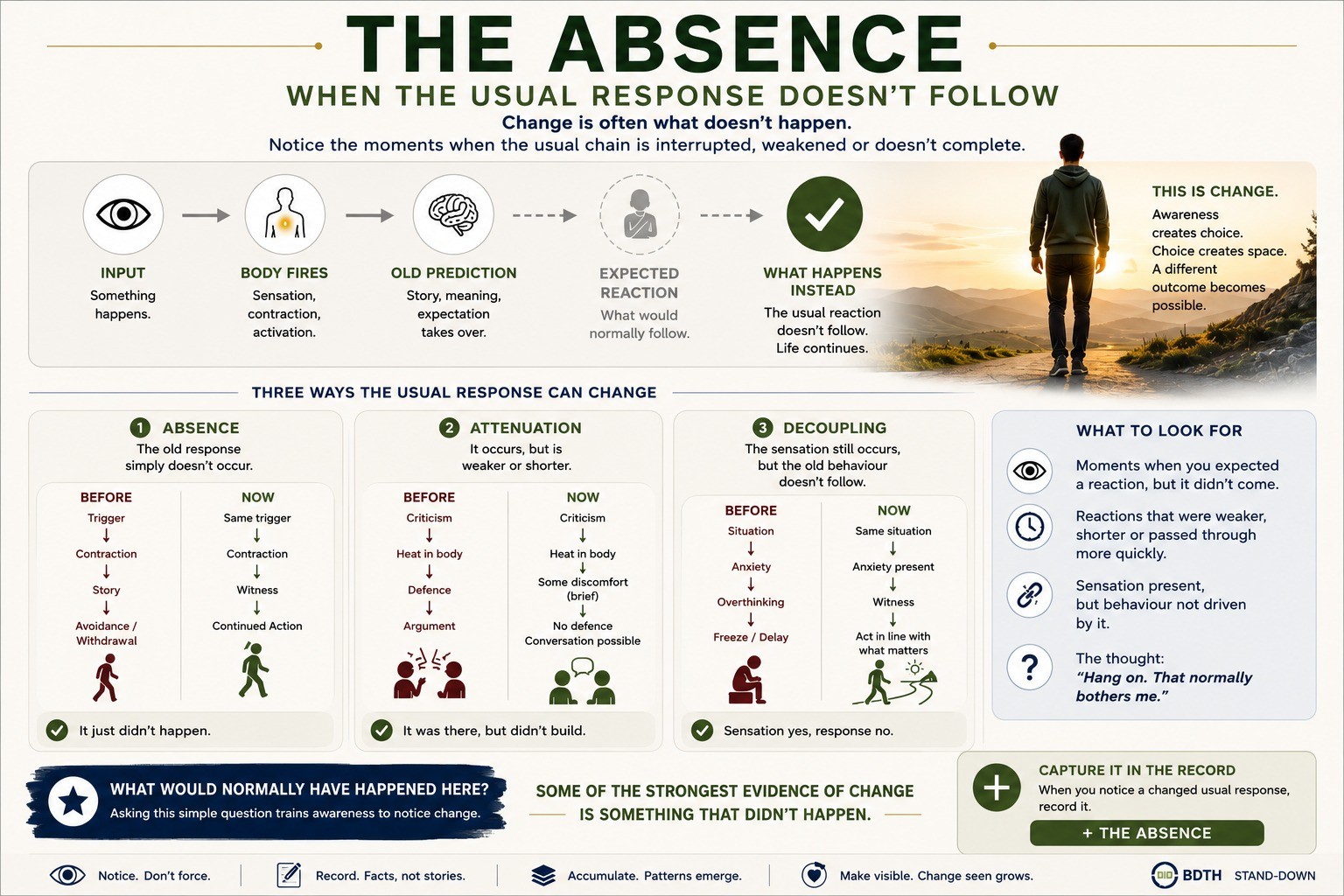
The Absence
How you'll know it's working.
Here is the part almost nobody warns you about. The clearest sign of change is usually not a new feeling arriving. It's an old one that doesn't. The reaction that always came, doesn't come. The dread that always followed the phone call simply isn't there. Change, more often than not, is something that quietly fails to happen. It's worth learning to notice, because the old machinery will always insist that nothing happened at all. The absence is the proof.

In the beginning there was coherence
The ground it all stands on.
One idea sits underneath everything else. You were coherent first (clear, whole, and working the way you were built to) before any of the interference layered itself on top. And that clarity never actually left; it was only covered over. So the sixty days don't build you a new self. They remove what has been obscuring the one that was there all along. You don't have to take this on faith. By the end it isn't a belief you hold. It's something you've felt for yourself: a plain fact of your own experience.